Incredible that I visited this very town that the video is showing footage of. So beautiful. The global fishing industry needs regulation, but regions where it is harvested on a mass scale such as Chile as hit the hardest by the ever-increasing demand and the lack of supply. This effects the pescaderos artesenales, or independent fisherman who depend on this for a living. Obviously the excessive use of hormones and the effects of bacteria are incredibly detrimental to the industry as well, not to mention the Chilean economy as a whole. This all can be tied into environmental impact, but the situation has economic and social impacts too.
Mark Scheffler March 4, 2009
Showing posts with label chile. Show all posts
Showing posts with label chile. Show all posts
Monday, March 23, 2009


Pinochet gets his own Museum of Memory
Not sure how I feel about this.
Defending the Dictator: History gets a rewrite at the Pinochet Museum
"Do we feel responsible for it? Yes. Do we feel guilt? No."
"For every young man we recover we will have one less communist" Dios mio...
Wednesday, December 24, 2008
Patagonia and Despedida
I know I know, it's been now multiple weeks since my last entry, but with good reason. I was down south at the Strait of Magellan and its surrounding areas for the last two weeks, followed by my two final days and Chile, and then a hop over to Buenos Aires to meet my family. I have had such a great, relaxing time recently and things have just been getting better now that my family and I have reunited.
So my journey began way back on Saturday December 6th. That day I had had to say goodbye to my host mother Lucrecia since she was traveling to Switzerland to visit her daughter and new born grandson for 3 months. That was very sad to have to say goodbye so early, but I have her email address of course as well as her Skype account so we can easily keep in touch. Anyways, my program buddy Finn and I had bought our tickets the month or so before to Punta Arenas, which is the largest city in the southern tip of Chile that you can fly to essentially and access the surrounding areas. Before we got on the plane, Finn's host family had organized an asado (giant tasty BBQ) to fill us up nicely before heading into the wilderness. We left from the lunch directly to airport, where I had to say my goodbyes to another program buddy, Dan, since he was going to be out of town (Santiago) when I got back because his family was coming down to visit and tour Chile for the holidays. I will see him back in the states for sure since he is from San Francisco.

That afternoon, we got on a 3 hour plane ride to Punta Arenas, where we stayed the night in a hostel with the plan of touring the town and picking up supplies over the course of two days before taking a bus to the city of Puerto Natales, the 'base-camp' town to the National Park of Torres del Paine. Strangely, we were able to pick-up our food for camping, last minute supplies, and tour the entire city in less than one day, so we decided to change our bus tickets to that afternoon rather than stay another night in Punta Arenas and leave the next morning. In terms of exploring the town, we visited a museum on the history of the region that was conveniently located across the street from where we were staying, walked through town and visited the central Plaza with a giant statue of Ferdinand Magellan, and visited the Strait of Magellan.

After a 3 hour bus ride to Puerto Natales, we took refuge in one of the three hostels all under the same name of "Erratic Rock." This hostel is a well run ship, with a great system and awesome owners. They are two friends from Oregon who decided to move to Puetro Natales and open their own hostel after visiting the national park, and now they are part of a co'op under the same name which has 3 hostels in Puerto Natales and one in Punta Arenas, all with the same system and feel. One in particular in Puerto Natales is a multi-function hostel, rental equipment provider, and information source for any questions about the park and the surrounding area. Each day at 3 p.m. they have an info-session for all backpackers. So we stopped by the hostel to talk to the owners about our plan to do the "W" trail in the park and how to arrange for bus to take us to the park. The next morning we left at 7 a.m.

Each leg of our journey is marked in a different color, with START and END labeled.
The bus ride to the National Park of Torres del Paine is about 2 and half hours with multiple stops depending on where you want to be dropped off. Normally foreigners have to pay $30 to enter the park, but since my buddy and I had Chilean identity cards, we only had to pay 8 dollars. Too bad the $22 dollars we saved went directly to buying tickets to ride a boat across Lake Pehoe(yellow line). The boat dropped us off at the base of the left side of the "W" trail and upon arrival we embarked on our hike up to "Glacier Grey." (light blue line)

The entire trail is 70 km, so our hikes from campsite to campsite were anywhere between 12-22 km. The initial hikes up to Glacier Gray was rough since we had all of our food, meaning backpacks were their heaviest, and our hiking legs we not yet up to speed. We decided to walk about an hour past the "Refugio Grey," which is a pay-campsite with a view of the glacier from a distance, to go to a free CONAF campsite (Chilean National Forestry Association), "Las Guardas" which had a view overlooking the glacier from above.

After a night at "Las Guardas," we packed up our gear and headed to the middle section of the "W," to a campsite called "Italiano" (green line). Along the way we managed to run into a couple of friends from our Education Aboard Program since the trails are essentially fixed meaning your bound to run into people. At times, it becomes a big of a nuisance because there are so many people visiting the park (200,000 a year) with the park only open less than 6 months, so we saw a lot of people: many Germans, Brits, Americans, Israelis, French, and few Chileans. Once we arrived at camp Italiano, we setup our tent in the crowded campsite, only afterward discovering that there was a much better location right next to the river that flows by and with no views of other campers. So we moved our gear to this prime location and realized there was no rush to leave the next day, so we hung around for 3 days. You can drink water straight out of the rivers since it's all glacier melt, some of the best water in the world. It was definitely the best campsite we stayed at (below).

The next day we took a day hike up to a lookout of "Los Cuernos" mountains about 2 hours up "Valle Frances," which represents the middle part of the "W" (pink line) After lunch at the lookout with many of campers, we decided to follow a not-so-often-walked trail up to higher elevation for a better view of the valley and to get away from the other campers. We walked through snow which was fun and the view was spectacular.

The rest of the time at Camp Italiano, Finn and I just hung out, read, and explored the nearby parts. Now 1t day 6 into our trip, we hiked out to the right side of the "W" to see the famous Torres del Paine that the park is named after (dark blue line). They are three rock towers that have glaciers melting just below them, forming dozens of waterfalls that in turn form a aquamarine lake that feeds into a river down the valley. It was essentially observing the entire water cycle in one view.

We had camped less than 45 minutes below the Torres at another free campsite(Campamiento Torres), spent 2 nights there, and on the third day left down the right side of the "W" to leave the park (orange line). The "W" takes most people only 3-4 days to complete, but we decided to take our time since we had enough to food to stay longer and we wanted to enjoy our time in the park. The experience was incredible, breathtaking, probably some of the most beautiful scenery I have ever seen in my life. We would have stayed longer had we brought more food, but there was just not enough space. So we left to park back to Puerto Natales.
We headed back to Erratic Rock to talk with the Oregon owners about another place nearby that we could camp since we had about 4 days until our flight back to Santiago from Punta Arenas. They recommended a Lake called Laguna Sofia, which is essentially a lake with the land surrounding it divided in half since it is owned by Cow ranchers. However, we were told it would not be a problem camping on private property and we would not see anybody while we were there, which seemed very appealing. So we got on the same bus that took us to the National Park, but told the driver to drop us off at an entrance to a private road about a half hour into the drive, where we would walk 7 km to the base of the lake, and then about another 5 km to the other side of the lake to camp.

During our walk, a 80's Mercedes drives up behind us and offers us a ride to the Lake. It turns out to be one of the two owners of the land, an Italian immigrant, who had no problem with us camping there and was very friendly. After being dropped off at the base of the lake, we walked to the other side and found a small bay with a bit of grass perfect for camping. We would stay there for two nights and leave on the third day.

The water of the lake was not too cold, so I decided to go for a swim.

On the walk back, we did not have any run-ins with any cars, so we had to walk to the entire trail back to the highway, where they we hitch-hiked with a truck driver back to Puerto Natales. We spent the afternoon to take a shower and have lunch in Puerto Natales, and then took an early evening bus to Punta Arenas. Once we got to Punta Arenas, we took refuge in the Erratic Rock for two days and planned to visit one of the Penguin Colonies and pickup souvenirs before leaving back to Santiago.
Seno Otway (Otway Sound), is a Penguin Colony of supposedly 8,000 Magellan Penguins, but it seemed like there were a bit less than that. Antarctic researchers who were on our small tour hypothesized that the tourist aspect of the colony might have scared away part of the population, but it was not clear since penguins always come back to the same place every year to breed before returning to the ocean once again. There were still plenty of penguins to see.

We also saw a couple Ñandús, which are the Chilean version of an ostrich. Weird creatures. They are endangered since they have been hunted for their feathers and their tasty meat.

We spent the night there, and had a flight the next morning around noon on the 19th. The entire 13 day experience in Patagonia, Chile was most certainly the most scenic trip I have ever taken. It is a unique part of the world with difficult weather (luckily there was hardly any rain during our entire trip), stunning views of nature and wildlife. Visiting the Strait of Magellan is probably to closest I'll get to Antarctica, and I hope one day I can come back and check out the Argentinian side of Patagonia as well.
It would be two quick days in Santiago to pack, pickup gifts, say goodbye to my friends, teachers, co-workers, and host dad, before I got on a plane for Buenos Aires. 6 months flew bye so fast, and if it were not for the fact that I have the graduate after this coming, I could have easily extended my stay another six months. I could also easily come back down to Latin America to work one day, but we'll have to wait and see. It was so tough saying goodbye to my host parents, they because part of my family and I became part of their's. We will keep in touch digitally, but I hope to one day see them again, either in the United States, Chile, or Europe where their daughters live.
So that ends my trip to Chile. I couldn't have expected a better experience, with all that learned in terms of the Spanish language(even though Chilean Spanish is full of so much slang and their owns words it is sometimes hard to talk with other Spanish speakers, but at the very least it is very easy for me to listen and understand others because Chilean talk to fast), all the history of Chile and Latin America that have given me a fuller perspective of the region and my own family history, the experience of being so culturally immersed in a new country while going to school working a job. There are so many similarities Chile has with California, but obviously very different in many ways as well. It is going to be a bit crazy coming back and adjusting to life in the United States, especially since I only have 3 months left of school before I hit to the real world. Pretty crazy. One thing I know for certain, I will definitely be coming back one day.
PS: I will continue this blog until I leave South America on the 4th of January. After that, I think I will create a new blog on my life going forward. It will have a new address and I will post a link here when I create site. But until then, I will have one or two most entries here on this blog. Cheers.
"El niño que no juega no es niño, pero el hombre que no juega perdió para siempre al niño que vivía en él y que le hará mucha falta."
English: “A child who does not play is not a child, but the man who doesn't play has lost forever the child who lived in him and who he will miss terribly.”
-Pablo Neruda
Chi-Chi-Chi...Le-Le-Le...Viva Chile.
So my journey began way back on Saturday December 6th. That day I had had to say goodbye to my host mother Lucrecia since she was traveling to Switzerland to visit her daughter and new born grandson for 3 months. That was very sad to have to say goodbye so early, but I have her email address of course as well as her Skype account so we can easily keep in touch. Anyways, my program buddy Finn and I had bought our tickets the month or so before to Punta Arenas, which is the largest city in the southern tip of Chile that you can fly to essentially and access the surrounding areas. Before we got on the plane, Finn's host family had organized an asado (giant tasty BBQ) to fill us up nicely before heading into the wilderness. We left from the lunch directly to airport, where I had to say my goodbyes to another program buddy, Dan, since he was going to be out of town (Santiago) when I got back because his family was coming down to visit and tour Chile for the holidays. I will see him back in the states for sure since he is from San Francisco.

That afternoon, we got on a 3 hour plane ride to Punta Arenas, where we stayed the night in a hostel with the plan of touring the town and picking up supplies over the course of two days before taking a bus to the city of Puerto Natales, the 'base-camp' town to the National Park of Torres del Paine. Strangely, we were able to pick-up our food for camping, last minute supplies, and tour the entire city in less than one day, so we decided to change our bus tickets to that afternoon rather than stay another night in Punta Arenas and leave the next morning. In terms of exploring the town, we visited a museum on the history of the region that was conveniently located across the street from where we were staying, walked through town and visited the central Plaza with a giant statue of Ferdinand Magellan, and visited the Strait of Magellan.

After a 3 hour bus ride to Puerto Natales, we took refuge in one of the three hostels all under the same name of "Erratic Rock." This hostel is a well run ship, with a great system and awesome owners. They are two friends from Oregon who decided to move to Puetro Natales and open their own hostel after visiting the national park, and now they are part of a co'op under the same name which has 3 hostels in Puerto Natales and one in Punta Arenas, all with the same system and feel. One in particular in Puerto Natales is a multi-function hostel, rental equipment provider, and information source for any questions about the park and the surrounding area. Each day at 3 p.m. they have an info-session for all backpackers. So we stopped by the hostel to talk to the owners about our plan to do the "W" trail in the park and how to arrange for bus to take us to the park. The next morning we left at 7 a.m.

Each leg of our journey is marked in a different color, with START and END labeled.
The bus ride to the National Park of Torres del Paine is about 2 and half hours with multiple stops depending on where you want to be dropped off. Normally foreigners have to pay $30 to enter the park, but since my buddy and I had Chilean identity cards, we only had to pay 8 dollars. Too bad the $22 dollars we saved went directly to buying tickets to ride a boat across Lake Pehoe(yellow line). The boat dropped us off at the base of the left side of the "W" trail and upon arrival we embarked on our hike up to "Glacier Grey." (light blue line)

The entire trail is 70 km, so our hikes from campsite to campsite were anywhere between 12-22 km. The initial hikes up to Glacier Gray was rough since we had all of our food, meaning backpacks were their heaviest, and our hiking legs we not yet up to speed. We decided to walk about an hour past the "Refugio Grey," which is a pay-campsite with a view of the glacier from a distance, to go to a free CONAF campsite (Chilean National Forestry Association), "Las Guardas" which had a view overlooking the glacier from above.

After a night at "Las Guardas," we packed up our gear and headed to the middle section of the "W," to a campsite called "Italiano" (green line). Along the way we managed to run into a couple of friends from our Education Aboard Program since the trails are essentially fixed meaning your bound to run into people. At times, it becomes a big of a nuisance because there are so many people visiting the park (200,000 a year) with the park only open less than 6 months, so we saw a lot of people: many Germans, Brits, Americans, Israelis, French, and few Chileans. Once we arrived at camp Italiano, we setup our tent in the crowded campsite, only afterward discovering that there was a much better location right next to the river that flows by and with no views of other campers. So we moved our gear to this prime location and realized there was no rush to leave the next day, so we hung around for 3 days. You can drink water straight out of the rivers since it's all glacier melt, some of the best water in the world. It was definitely the best campsite we stayed at (below).

The next day we took a day hike up to a lookout of "Los Cuernos" mountains about 2 hours up "Valle Frances," which represents the middle part of the "W" (pink line) After lunch at the lookout with many of campers, we decided to follow a not-so-often-walked trail up to higher elevation for a better view of the valley and to get away from the other campers. We walked through snow which was fun and the view was spectacular.

The rest of the time at Camp Italiano, Finn and I just hung out, read, and explored the nearby parts. Now 1t day 6 into our trip, we hiked out to the right side of the "W" to see the famous Torres del Paine that the park is named after (dark blue line). They are three rock towers that have glaciers melting just below them, forming dozens of waterfalls that in turn form a aquamarine lake that feeds into a river down the valley. It was essentially observing the entire water cycle in one view.

We had camped less than 45 minutes below the Torres at another free campsite(Campamiento Torres), spent 2 nights there, and on the third day left down the right side of the "W" to leave the park (orange line). The "W" takes most people only 3-4 days to complete, but we decided to take our time since we had enough to food to stay longer and we wanted to enjoy our time in the park. The experience was incredible, breathtaking, probably some of the most beautiful scenery I have ever seen in my life. We would have stayed longer had we brought more food, but there was just not enough space. So we left to park back to Puerto Natales.
We headed back to Erratic Rock to talk with the Oregon owners about another place nearby that we could camp since we had about 4 days until our flight back to Santiago from Punta Arenas. They recommended a Lake called Laguna Sofia, which is essentially a lake with the land surrounding it divided in half since it is owned by Cow ranchers. However, we were told it would not be a problem camping on private property and we would not see anybody while we were there, which seemed very appealing. So we got on the same bus that took us to the National Park, but told the driver to drop us off at an entrance to a private road about a half hour into the drive, where we would walk 7 km to the base of the lake, and then about another 5 km to the other side of the lake to camp.

During our walk, a 80's Mercedes drives up behind us and offers us a ride to the Lake. It turns out to be one of the two owners of the land, an Italian immigrant, who had no problem with us camping there and was very friendly. After being dropped off at the base of the lake, we walked to the other side and found a small bay with a bit of grass perfect for camping. We would stay there for two nights and leave on the third day.

The water of the lake was not too cold, so I decided to go for a swim.

On the walk back, we did not have any run-ins with any cars, so we had to walk to the entire trail back to the highway, where they we hitch-hiked with a truck driver back to Puerto Natales. We spent the afternoon to take a shower and have lunch in Puerto Natales, and then took an early evening bus to Punta Arenas. Once we got to Punta Arenas, we took refuge in the Erratic Rock for two days and planned to visit one of the Penguin Colonies and pickup souvenirs before leaving back to Santiago.
Seno Otway (Otway Sound), is a Penguin Colony of supposedly 8,000 Magellan Penguins, but it seemed like there were a bit less than that. Antarctic researchers who were on our small tour hypothesized that the tourist aspect of the colony might have scared away part of the population, but it was not clear since penguins always come back to the same place every year to breed before returning to the ocean once again. There were still plenty of penguins to see.

We also saw a couple Ñandús, which are the Chilean version of an ostrich. Weird creatures. They are endangered since they have been hunted for their feathers and their tasty meat.

We spent the night there, and had a flight the next morning around noon on the 19th. The entire 13 day experience in Patagonia, Chile was most certainly the most scenic trip I have ever taken. It is a unique part of the world with difficult weather (luckily there was hardly any rain during our entire trip), stunning views of nature and wildlife. Visiting the Strait of Magellan is probably to closest I'll get to Antarctica, and I hope one day I can come back and check out the Argentinian side of Patagonia as well.
It would be two quick days in Santiago to pack, pickup gifts, say goodbye to my friends, teachers, co-workers, and host dad, before I got on a plane for Buenos Aires. 6 months flew bye so fast, and if it were not for the fact that I have the graduate after this coming, I could have easily extended my stay another six months. I could also easily come back down to Latin America to work one day, but we'll have to wait and see. It was so tough saying goodbye to my host parents, they because part of my family and I became part of their's. We will keep in touch digitally, but I hope to one day see them again, either in the United States, Chile, or Europe where their daughters live.
So that ends my trip to Chile. I couldn't have expected a better experience, with all that learned in terms of the Spanish language(even though Chilean Spanish is full of so much slang and their owns words it is sometimes hard to talk with other Spanish speakers, but at the very least it is very easy for me to listen and understand others because Chilean talk to fast), all the history of Chile and Latin America that have given me a fuller perspective of the region and my own family history, the experience of being so culturally immersed in a new country while going to school working a job. There are so many similarities Chile has with California, but obviously very different in many ways as well. It is going to be a bit crazy coming back and adjusting to life in the United States, especially since I only have 3 months left of school before I hit to the real world. Pretty crazy. One thing I know for certain, I will definitely be coming back one day.
PS: I will continue this blog until I leave South America on the 4th of January. After that, I think I will create a new blog on my life going forward. It will have a new address and I will post a link here when I create site. But until then, I will have one or two most entries here on this blog. Cheers.
"El niño que no juega no es niño, pero el hombre que no juega perdió para siempre al niño que vivía en él y que le hará mucha falta."
English: “A child who does not play is not a child, but the man who doesn't play has lost forever the child who lived in him and who he will miss terribly.”
-Pablo Neruda
Chi-Chi-Chi...Le-Le-Le...Viva Chile.
Thursday, November 20, 2008
Chile offers striking workers a 9.5 percent raise
The government of Chile has offered nearly half a million striking municipal workers a 9.5 percent wage increase and the Congress is expected to vote on it Thursday, officials said.

The 450,000 workers, who have been on strike since Monday, are asking for a 14.5 percent pay increase. The government had initially offered a 6.5 percent increase.
A 9.5 percent increase would be the highest since the 9.9 percent accorded in 1997, El Mercurio newspaper reported.
Striking workers have taken to the streets this week, marching in most of the nation's major cities.
The nation was paralyzed for two days last week when the workers went on strike. The public employees have not set an end date for the strike.
Because of the strike, garbage is piling up on streets, tax and fee collection has stopped and public health and education are practically paralyzed. Even weddings and autopsies are not being performed.
source
---
There is a lot to say about the current strike. This article does not state that the reason for the demand for a raise in salary is because of the cost of living has gone up 10% from last year, nor that their first offer was a measly 4.5%. People are going to be very disappointed if the raise is not at least double-digits and it's not like the government does not have the fund. Also, the government is stubborn to make a quick, drastic decision because of the fear that if they grant the 14.5% request, soon the private sector will be asking for a similar changes, and many members of the government obviously have ties to these companies that will be affected. Also, the discussion is difficult because a simple raise to every public worker doesn't make sense...should executives of these public companies receive the same salary increase as a lower-class, less specialized worker? The same thinking applies to those who aren't very good workers, why should they be rewarded for their bad performance? I had a class canceled for a day because of this strike, and there is so much horrible stress placed on the country of Chile economically and socially. The host mother of my buddy Finn had a heart attack (thankfully she is o.k.) because she is one of the few working in her sector of the government and is a workaholic, so while others are striking she is working twice as hard and the extra stress was the cause.
Update: Thankfully the Congress approved a 10% raise in municipal salaries late Thursday afternoon and the strikes will stop. The readjustment also includes two bonds: one of $200,000 mil and one of $100,000 according to the salary tranche.
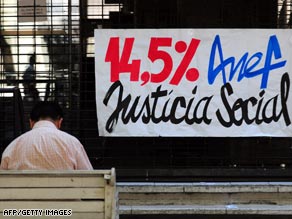
The 450,000 workers, who have been on strike since Monday, are asking for a 14.5 percent pay increase. The government had initially offered a 6.5 percent increase.
A 9.5 percent increase would be the highest since the 9.9 percent accorded in 1997, El Mercurio newspaper reported.
Striking workers have taken to the streets this week, marching in most of the nation's major cities.
The nation was paralyzed for two days last week when the workers went on strike. The public employees have not set an end date for the strike.
Because of the strike, garbage is piling up on streets, tax and fee collection has stopped and public health and education are practically paralyzed. Even weddings and autopsies are not being performed.
source
---
There is a lot to say about the current strike. This article does not state that the reason for the demand for a raise in salary is because of the cost of living has gone up 10% from last year, nor that their first offer was a measly 4.5%. People are going to be very disappointed if the raise is not at least double-digits and it's not like the government does not have the fund. Also, the government is stubborn to make a quick, drastic decision because of the fear that if they grant the 14.5% request, soon the private sector will be asking for a similar changes, and many members of the government obviously have ties to these companies that will be affected. Also, the discussion is difficult because a simple raise to every public worker doesn't make sense...should executives of these public companies receive the same salary increase as a lower-class, less specialized worker? The same thinking applies to those who aren't very good workers, why should they be rewarded for their bad performance? I had a class canceled for a day because of this strike, and there is so much horrible stress placed on the country of Chile economically and socially. The host mother of my buddy Finn had a heart attack (thankfully she is o.k.) because she is one of the few working in her sector of the government and is a workaholic, so while others are striking she is working twice as hard and the extra stress was the cause.
Update: Thankfully the Congress approved a 10% raise in municipal salaries late Thursday afternoon and the strikes will stop. The readjustment also includes two bonds: one of $200,000 mil and one of $100,000 according to the salary tranche.
Saturday, October 18, 2008
La Serena and the ensuing week
I took off on a four and half hour drive to La Serena. My buddy Finn and his parents had already arrived the night before to get a lay of the land. Upon arriving, we all got together for a quality seafood dinner on the beach-front and went to bed early to prepare for the following day.
After a solid breakfast of bread, fruit, and coffee, our two-car crew headed inland for the day. On the way we stopped at a beautiful reservoir, Embalse Puclaro, for a photo op, then continued on to the town of Vicuña. Once in town, we took a tour of the Gabriela Mistral museum, which inside was relatively boring, but it had an amazing garden in it's back lot that was incredibly peaceful. Following a slow walk through the town, we got back in the cars and continued our drive out to the Valle de Elqui.

This valley has to be one of the most beautiful places I have ever seen. It is covered with miles upon miles of grape vines, sadly not dedicated to the production of wine, but of pisco. While it is tough to find pisco in the United States, and even if you do it is quite expensive, it is certainly the liquor of choice in Chile. There are numerous brands and strengths...I think of it as the Chilean equivalent of Mexican tequila, but you can mix it with coke (piscola) or combine with sweet and sour (pisco sour) or papaya juice as we discovered later in the day to make a "Serena Sour." The vistas were simply incredibly as we drove along the windy road through the valley.

We eventually got deep into the valley to the town of Pisco Elqui, where we stopped to have a classic Chilean lunch followed by a tour of the Mistral pisco factory. The tour guide did not have the best voice for tours, but the factory had amazing architecture and it was interesting to learn about the whole process. Following the tour, we drove back out the valley which was twice as pretty as when we entered, with the sun going down, shining on the hillsides.

On our way back to La Serena, we stopped at a family friend's house of the host brother of Finn, Alejandro Ramirez, whose cousin is Norma Ramirez, an incredibly talented artist. She is married to a Mexican artist, Luis Gastélum, and we were very lucky to stop by their place for drinks, snacks, and a chat. Their house is amazing, walls and floors made of mosaic, and their located right next to a river that you can hear from the inside of the house. Norma helped a group of artists design many of the projects that are in the Parque de Paz in Villa Grimaldi and is currently doing various exhibitions here in Chile.
The following morning, I left early with Finn and his parents on a drive back to Santiago. This drive was gorgeous as well. It reminded me a lot of Southern California with the coastal vegetation, but also very different since there are views of the Andes mountains in site as well. The area is also much less populated, but every so often there are small resort resort communities near the beach. At one point on the way back, Finn's mother decided that she wanted to show Finn and I this town that her and her and her husband had discovered earlier in the week while looking for a place they could play tennis. The town, Zapallar.

This place was remarkable. Green and lush, Zapallar is a small bay inhabited by upper-class Chileans and used as a weekend getaway destination. With very little roads, the town is made of mostly of walking trails. On one end of the bay, there is a rock mountain with a single tree situated on top, quite picturesque. We walked through the entire town in fifteen minutes, and then sat down for seafood appetizers as a quick break in between our ride home. Too bad Zapallar isn't enjoyed by everyone in Chile, only the privileged, but I guess I can understand why with it's size and limited housing. Still, quite a magical place.
Once back in Santiago, I stopped by Bar Basic to find out the situation with my new job. The owners said they wanted me to come in the next day for some training. What I did not realize was that this training was as a bartender; I thought I was going to be a server. Well, turns out I am happier as a bartender since it is something I haven't done before and I get to practice my Spanish with the Chilean servers as they request drinks. I'll be working there 2 days a week, Sundays and Mondays, which works out great cause I am usually in there every Sunday anyways and now I get to get paid. The salary is 2 dollars an hour, but I get all the tips from people who sit at the bar, as well as 30% of the tips from the regular tables. Comes out to a decent rate, especially by Chilean standards.
Wednesday was the date of the big game, Argentina v Chile. Since two of Argentina's best players, Juan Román Riquelme, Carlos Tevez, were both suspended after receiving red cards in their previous match against Uruguay, the match up was more favorable than it could have been, but most Chileans still figured Argentina and their infinite supply of futbol talent would be able to pull off the win. This is especially true since Chile has not beaten Argentina in any sort of futbol match in 30 years, and never in a FIFA-official match. This all changed on Wednesday night, as Chile won 1-0, with a fantastic goal by a 22 year old striker, Fabian Orellana with only 7 national game appearances. After the match was over, 3,000 people got together in celebration downtown. In addition, Argentina's coach, Alfio Basile, quit following the loss. Chile is now tied with Argentina for 3rd in the South America group in qualifying for World Cup 2010 in South Africa, and does not play another qualifying match until March of 2009.
On Thursday of this past week, I turned in an essay for my Gringo 101 class, the second of three essays and once again it had a free topic based on what we had learned over the past couple weeks. I chose to write mine on how a social democracy is the best system for Chile when compared to the political-economic systems of the past 30 years. Eh.
Not too much else is going on in my world down here. I got work tonight and tomorrow, and municipal elections are coming up here in Chile. These are a big deal for the country since depending how each municipality votes, it will determine which candidate "La Concertacion" or the group of leftists parties, will select to run against conservative Sebastián Piñera. There are posters covering every street corner, while political aides hand out flyers to passer-byers.
I am currently looking up some options for a weekend fishing trip somewhere down south for the second week of November, but prices are looking a bit steep at the moment. It is so strange to think that it is practically the end of October already. The countdown till the end of the program has begun, but I don't want it to end. Wish I had the time to do so much more, but I also understand I am here to study. I don't need to lament, I am sure I'll be back.
->I'll be posting more pictures from the weekend within the next couple days. I am waiting on my buddies to give me copies.
After a solid breakfast of bread, fruit, and coffee, our two-car crew headed inland for the day. On the way we stopped at a beautiful reservoir, Embalse Puclaro, for a photo op, then continued on to the town of Vicuña. Once in town, we took a tour of the Gabriela Mistral museum, which inside was relatively boring, but it had an amazing garden in it's back lot that was incredibly peaceful. Following a slow walk through the town, we got back in the cars and continued our drive out to the Valle de Elqui.

This valley has to be one of the most beautiful places I have ever seen. It is covered with miles upon miles of grape vines, sadly not dedicated to the production of wine, but of pisco. While it is tough to find pisco in the United States, and even if you do it is quite expensive, it is certainly the liquor of choice in Chile. There are numerous brands and strengths...I think of it as the Chilean equivalent of Mexican tequila, but you can mix it with coke (piscola) or combine with sweet and sour (pisco sour) or papaya juice as we discovered later in the day to make a "Serena Sour." The vistas were simply incredibly as we drove along the windy road through the valley.

We eventually got deep into the valley to the town of Pisco Elqui, where we stopped to have a classic Chilean lunch followed by a tour of the Mistral pisco factory. The tour guide did not have the best voice for tours, but the factory had amazing architecture and it was interesting to learn about the whole process. Following the tour, we drove back out the valley which was twice as pretty as when we entered, with the sun going down, shining on the hillsides.

On our way back to La Serena, we stopped at a family friend's house of the host brother of Finn, Alejandro Ramirez, whose cousin is Norma Ramirez, an incredibly talented artist. She is married to a Mexican artist, Luis Gastélum, and we were very lucky to stop by their place for drinks, snacks, and a chat. Their house is amazing, walls and floors made of mosaic, and their located right next to a river that you can hear from the inside of the house. Norma helped a group of artists design many of the projects that are in the Parque de Paz in Villa Grimaldi and is currently doing various exhibitions here in Chile.
The following morning, I left early with Finn and his parents on a drive back to Santiago. This drive was gorgeous as well. It reminded me a lot of Southern California with the coastal vegetation, but also very different since there are views of the Andes mountains in site as well. The area is also much less populated, but every so often there are small resort resort communities near the beach. At one point on the way back, Finn's mother decided that she wanted to show Finn and I this town that her and her and her husband had discovered earlier in the week while looking for a place they could play tennis. The town, Zapallar.
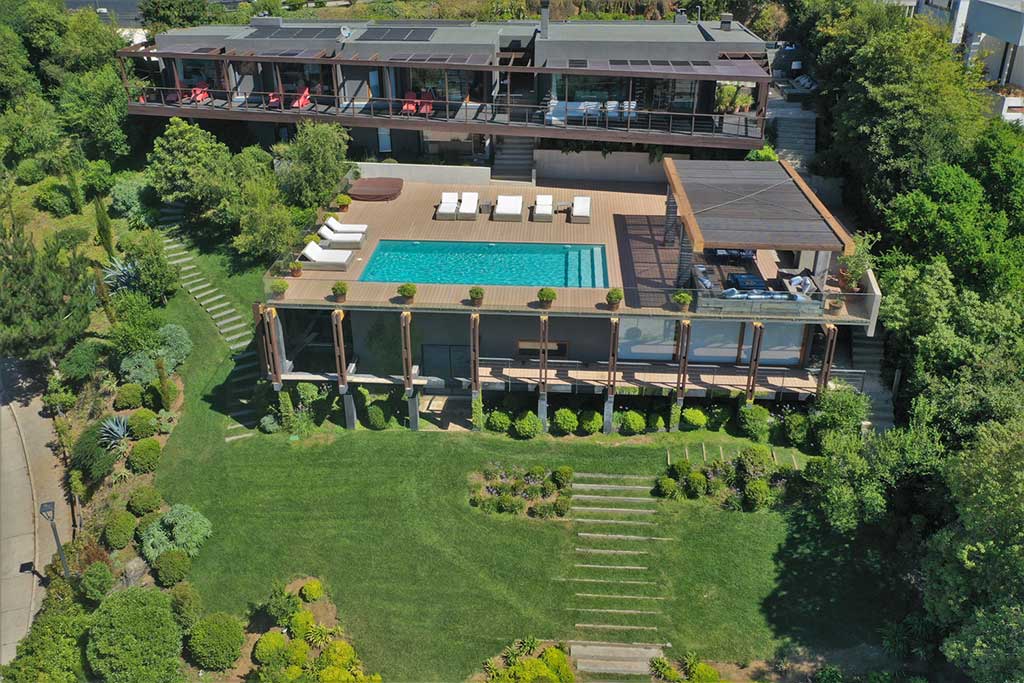
This place was remarkable. Green and lush, Zapallar is a small bay inhabited by upper-class Chileans and used as a weekend getaway destination. With very little roads, the town is made of mostly of walking trails. On one end of the bay, there is a rock mountain with a single tree situated on top, quite picturesque. We walked through the entire town in fifteen minutes, and then sat down for seafood appetizers as a quick break in between our ride home. Too bad Zapallar isn't enjoyed by everyone in Chile, only the privileged, but I guess I can understand why with it's size and limited housing. Still, quite a magical place.
Once back in Santiago, I stopped by Bar Basic to find out the situation with my new job. The owners said they wanted me to come in the next day for some training. What I did not realize was that this training was as a bartender; I thought I was going to be a server. Well, turns out I am happier as a bartender since it is something I haven't done before and I get to practice my Spanish with the Chilean servers as they request drinks. I'll be working there 2 days a week, Sundays and Mondays, which works out great cause I am usually in there every Sunday anyways and now I get to get paid. The salary is 2 dollars an hour, but I get all the tips from people who sit at the bar, as well as 30% of the tips from the regular tables. Comes out to a decent rate, especially by Chilean standards.
Wednesday was the date of the big game, Argentina v Chile. Since two of Argentina's best players, Juan Román Riquelme, Carlos Tevez, were both suspended after receiving red cards in their previous match against Uruguay, the match up was more favorable than it could have been, but most Chileans still figured Argentina and their infinite supply of futbol talent would be able to pull off the win. This is especially true since Chile has not beaten Argentina in any sort of futbol match in 30 years, and never in a FIFA-official match. This all changed on Wednesday night, as Chile won 1-0, with a fantastic goal by a 22 year old striker, Fabian Orellana with only 7 national game appearances. After the match was over, 3,000 people got together in celebration downtown. In addition, Argentina's coach, Alfio Basile, quit following the loss. Chile is now tied with Argentina for 3rd in the South America group in qualifying for World Cup 2010 in South Africa, and does not play another qualifying match until March of 2009.
On Thursday of this past week, I turned in an essay for my Gringo 101 class, the second of three essays and once again it had a free topic based on what we had learned over the past couple weeks. I chose to write mine on how a social democracy is the best system for Chile when compared to the political-economic systems of the past 30 years. Eh.
Not too much else is going on in my world down here. I got work tonight and tomorrow, and municipal elections are coming up here in Chile. These are a big deal for the country since depending how each municipality votes, it will determine which candidate "La Concertacion" or the group of leftists parties, will select to run against conservative Sebastián Piñera. There are posters covering every street corner, while political aides hand out flyers to passer-byers.
I am currently looking up some options for a weekend fishing trip somewhere down south for the second week of November, but prices are looking a bit steep at the moment. It is so strange to think that it is practically the end of October already. The countdown till the end of the program has begun, but I don't want it to end. Wish I had the time to do so much more, but I also understand I am here to study. I don't need to lament, I am sure I'll be back.
->I'll be posting more pictures from the weekend within the next couple days. I am waiting on my buddies to give me copies.
Sunday, September 28, 2008
Chile's Military
From this week's issues of the Economist:
Chile's Army seeks to bury its murky past
Thanks to record prices for copper, Chile’s main export, and an odd arrangement (predating Mr Pinochet) under which Codelco, the state copper producer, transfers 10% of its export revenues (amounting to $1.4 billion last year) to the armed forces for capital expenditure, there has been money to spend. The finance ministry has the last word, but the army has been able to shop extensively, with acquisitions including German tanks and better electronics. Today, Chile’s is the most modern and best-equipped army in Latin America, says Armen Kouyoumdjian, an adviser to the Stockholm International Peace Research Institute.
Chile's Army seeks to bury its murky past
Thanks to record prices for copper, Chile’s main export, and an odd arrangement (predating Mr Pinochet) under which Codelco, the state copper producer, transfers 10% of its export revenues (amounting to $1.4 billion last year) to the armed forces for capital expenditure, there has been money to spend. The finance ministry has the last word, but the army has been able to shop extensively, with acquisitions including German tanks and better electronics. Today, Chile’s is the most modern and best-equipped army in Latin America, says Armen Kouyoumdjian, an adviser to the Stockholm International Peace Research Institute.
Tuesday, September 9, 2008
Another Break
I can't get enough of how loose studies have been here in Chile this semester. Just as I am getting accustomed to my schedule and routine, essentially all my classes take a two week break for 11th of Sept (The Anniversary of the first day of Pinochet's coup), and then the 18th is the beginning of the Independence weekend that essentially last an entire week. Not that I have any problems with any of this, especially since my Grandmother is coming for 5 days next week. I just feel like total number of classes is quite limited by the political fervor...
Speaking of, last Thursday I had my full day's schedule until about 3:30 p.m. (right in the middle of my last class at the University of Chile campus), when class was canceled due to an on campus riot brewing right outside the classroom door. The teacher refused to halt class after two recommendations from passer-byres outside the classroom, but once the tear gas started seeping in creating tremendous discomfort to half the class, it was time to leave. Apparently is was 'Combatant Day' because a few years back a student was killed by police during a protest. In turn, a couple dozen students on campus covered their faces with cloth to protect themselves from the gas as well as their identities while constructing Molotov cocktails and throwing rocks at riot police just outside the campus walls. After fifteen minutes or so, large riot vehicles with water cannons mounted on top rolled in to blast anyone in range. Police also launched tear gas capsules over a good portion of the campus. Definitely one of the most horrible feelings of my life after breathing that stuff in. A couple students were able to get direct shots with their Molotovs on the vehicles, but eventually I assumed they were subdued; I didn't stick around to find out.
On Friday I went out to lunch with my host-father; always entertaining. He loves to talk about anything (sports and politics are most common between us) and always has interesting stories and great jokes. Afterward, I went to a part supply store to pickup some face-paint for the Chile futbol match that coming Sunday. That evening I went to go see a Chilean documentary about the most prestigious futbol club in Chile (Colo-Colo), which explained the reasoning behind the devout passion for the team while following the head of a faction who had recently been paralyzed after a fight between fellow fans. I found it amusing that before the film started, a person representing the film stood up to warn the audience not to riot in the theater or brak anything since the night before two movie theaters had just that happen. the film was obviously a bit biased, but did hint at the gang-like structure of these groups of fans (drugs, mob-like hits on opposing fans or even fellow fans).

All day Saturday was spent at a mining town called Sewell, the mine: el Teniente. This high altitude mine is the deepest in the world in terms of below the surface depth rather than true elevation, and was once a massive community of Chilean workers run by primarily by American industrialists. Now it is controlled by the Chilean company Codelco and remains an important part of the national economy. We got a thorough underground tour as well as a guide-led walk through the snow-covered city.


Sunday I went with my host-father and two buddies to the enormous Bio Bio market in the Franklin barrio. This part of the town is the oldest in the city of Santiago, and is packed with street vendors for blocks. My host-father joked that if you were looking for an elephant, I am sure you could find someone who was selling it. I was in search of a Chilean national team futbol jersey, but ended up buying a Universidad de Chile jersey instead. I'll have more chances to get a jersey, and with more selection. Surprisingly there weren't many jerseys, but then again most of the stuff for sale is second hand or stolen so I can't complain. The afternoon I spent at a Gringo bar called Bar Basico to watch the opening weekend of American football. The owner of the bar is from Bakersfield and started the restaurant since there is no place in the city where you can get a quality burrito nor Cheeseburger. They also have a premium satellite package to get all the football games. I'll be back many a weekends for sure.
That evening was the Chile vs. Brazil futbol match that I had long been awaiting. Too bad Brazil took care of business winning 3-0. Chile played sloppily, took no advantage of their scoring opportunities, and lost one of their best players for the next two games because of red card (cleats up tackle). The stadium was totally packed and the game was such a disappointment. Not that I expected Chile to win, but certainly a better showing for the home crowd. The experience was unlike any sporting event I had been to and hopefully I can see a win on Wednesday when they take on Colombia. This match is the deciding game whether Chile or Brazil qualify for the World Cup in 2010. Each have the same number of point in the South American group, and the loser will almost certainly be out of contention. Below my very quick and rough Photoshop job of the field.

Monday was a light day of reading for class, watching the tennis finals of the U.S. open, and the late Monday Night football games. It's fun to watch sports in Spanish since the positions, rules, plays all have different names/words that you would expect and the primarily Argentinian announcer commentary is priceless. Trying to clearly explain all of the American football facets to my host father is even more difficult.
With a partial day of class today, there wasn't too much news from today other than a couple of my class test dates have been decided and that there is essentially no school for the next two weeks other than a single class next Tuesday. I am getting more and more anxious for my Grandmother to come: we are going to have so much fun. I had one of the program director's email me a list of holiday activities going on throughout the city that I will combine with my own personal itinerary of stuff to do as well. Hopefully the weather picks up a little bit; it's been overcast.smoggy the past few days following some excellent early-spring sun and warm weather.
Chile has got to win tomorrow...Chi, chi, chi...le, le, le...viva Chile! Vamos...vamos Chilenos...esta noche...tenemos que ganar!!!!

Above myself, Daniel Nemrioff and Finn Telles
Speaking of, last Thursday I had my full day's schedule until about 3:30 p.m. (right in the middle of my last class at the University of Chile campus), when class was canceled due to an on campus riot brewing right outside the classroom door. The teacher refused to halt class after two recommendations from passer-byres outside the classroom, but once the tear gas started seeping in creating tremendous discomfort to half the class, it was time to leave. Apparently is was 'Combatant Day' because a few years back a student was killed by police during a protest. In turn, a couple dozen students on campus covered their faces with cloth to protect themselves from the gas as well as their identities while constructing Molotov cocktails and throwing rocks at riot police just outside the campus walls. After fifteen minutes or so, large riot vehicles with water cannons mounted on top rolled in to blast anyone in range. Police also launched tear gas capsules over a good portion of the campus. Definitely one of the most horrible feelings of my life after breathing that stuff in. A couple students were able to get direct shots with their Molotovs on the vehicles, but eventually I assumed they were subdued; I didn't stick around to find out.
On Friday I went out to lunch with my host-father; always entertaining. He loves to talk about anything (sports and politics are most common between us) and always has interesting stories and great jokes. Afterward, I went to a part supply store to pickup some face-paint for the Chile futbol match that coming Sunday. That evening I went to go see a Chilean documentary about the most prestigious futbol club in Chile (Colo-Colo), which explained the reasoning behind the devout passion for the team while following the head of a faction who had recently been paralyzed after a fight between fellow fans. I found it amusing that before the film started, a person representing the film stood up to warn the audience not to riot in the theater or brak anything since the night before two movie theaters had just that happen. the film was obviously a bit biased, but did hint at the gang-like structure of these groups of fans (drugs, mob-like hits on opposing fans or even fellow fans).

All day Saturday was spent at a mining town called Sewell, the mine: el Teniente. This high altitude mine is the deepest in the world in terms of below the surface depth rather than true elevation, and was once a massive community of Chilean workers run by primarily by American industrialists. Now it is controlled by the Chilean company Codelco and remains an important part of the national economy. We got a thorough underground tour as well as a guide-led walk through the snow-covered city.


Sunday I went with my host-father and two buddies to the enormous Bio Bio market in the Franklin barrio. This part of the town is the oldest in the city of Santiago, and is packed with street vendors for blocks. My host-father joked that if you were looking for an elephant, I am sure you could find someone who was selling it. I was in search of a Chilean national team futbol jersey, but ended up buying a Universidad de Chile jersey instead. I'll have more chances to get a jersey, and with more selection. Surprisingly there weren't many jerseys, but then again most of the stuff for sale is second hand or stolen so I can't complain. The afternoon I spent at a Gringo bar called Bar Basico to watch the opening weekend of American football. The owner of the bar is from Bakersfield and started the restaurant since there is no place in the city where you can get a quality burrito nor Cheeseburger. They also have a premium satellite package to get all the football games. I'll be back many a weekends for sure.
That evening was the Chile vs. Brazil futbol match that I had long been awaiting. Too bad Brazil took care of business winning 3-0. Chile played sloppily, took no advantage of their scoring opportunities, and lost one of their best players for the next two games because of red card (cleats up tackle). The stadium was totally packed and the game was such a disappointment. Not that I expected Chile to win, but certainly a better showing for the home crowd. The experience was unlike any sporting event I had been to and hopefully I can see a win on Wednesday when they take on Colombia. This match is the deciding game whether Chile or Brazil qualify for the World Cup in 2010. Each have the same number of point in the South American group, and the loser will almost certainly be out of contention. Below my very quick and rough Photoshop job of the field.

Monday was a light day of reading for class, watching the tennis finals of the U.S. open, and the late Monday Night football games. It's fun to watch sports in Spanish since the positions, rules, plays all have different names/words that you would expect and the primarily Argentinian announcer commentary is priceless. Trying to clearly explain all of the American football facets to my host father is even more difficult.
With a partial day of class today, there wasn't too much news from today other than a couple of my class test dates have been decided and that there is essentially no school for the next two weeks other than a single class next Tuesday. I am getting more and more anxious for my Grandmother to come: we are going to have so much fun. I had one of the program director's email me a list of holiday activities going on throughout the city that I will combine with my own personal itinerary of stuff to do as well. Hopefully the weather picks up a little bit; it's been overcast.smoggy the past few days following some excellent early-spring sun and warm weather.
Chile has got to win tomorrow...Chi, chi, chi...le, le, le...viva Chile! Vamos...vamos Chilenos...esta noche...tenemos que ganar!!!!

Above myself, Daniel Nemrioff and Finn Telles
Monday, August 25, 2008
Yay school!
Now I can start getting into a solid routine here with my first week of classes under my belt. Monday I was able to pickup my Chilean identity card, finally. I also went to pickup my course reader (costs $15!) for the mandatory program course so I could take care of the reading due the following evening. Tuesday at 8 a.m. I had my first class, Economia II. I am so happy I actually get to take an Economics class. This one is particularly interesting because it is one, with a sociological perspective as opposed to straight economics, and two, it is essentially three classes wrapped into one. What I mean by that is that I have three professors for the course, each of whom will use a third of the course to teach their topic of instruction and give a test on the material at the end of each part. I begin with macroeconomics, wasn't sure what the second theme was because I couldn't read the teacher's handwriting, and the third part is Economic Development in Chile, which sounds fantastic. I am happily the only foreign student in the class, of about 25 students.

My first impressions of school are as follows. One, my campus is quite liberal and diverse, which I obviously like. This manifests itself as variety of clothing styles, on campus drinking and smoking in social circles between and after class, and tons of on campus graffiti. One that caught my attention: "Bachelet rima con Pinochet" trans-> Bachelet (current president) rhymes with Pinochet (former dictator). The other observation I had about life is that none of the Chileans seriously consider the concept of punctuality. I was two minute early to my first class and the only person in the room was the professor. Most of the class arrived within 10-20 after it should have started. Not that I'm complaining or anything...

My second class, luckily in the same classroom, is a Social History of Latin America. As was the case previously, most of the class showed up late, including the teacher. Sadly this class is filled with foreign students, some from my program other from other abroad programs. We probably represent the majority. This is important to note since the professor of this class has a unique view on the history and development of Latin America and tends to announce his stern points about the United States (most of which are true) directly at a specific foreign student. Cracks me up. From the two classes I have had so far, this class seems very interesting and the teacher tremendously insightful. Just with their weren't so many gringos.
Following the these two back-to-back classes that take place Tuesday/Thursday, I have a nice, long break for lunch. At 7 p.m., the entire program has a dull history class located far from my apartment. I left on Tuesday at 6, and showed up a half hour late because of all the subway traffic. It's a battle down there; I missed 6 straight, packed subways. Strangely when I left at 5:30 on Thursday, transit was a breeze and arrived at 6:10. Bah! The course is a tough time of the day for us to be in class, but I assume they were forced to do this in order to avoid interfering with student's desired schedules of other University courses. Luckily we will have some interesting guest speakers every once in a while to break the trend. For now, its painful.
Wednesday I only had a three hour long class on rural life in Chile and the problems that these agricultural valleys encounter that started at 10:15 a.m. The location of this class was not clear on the first day and the teacher showed up 45 minutes late to his intended classroom. After an hour discussion in a small room about, we had a ten minute break and met back up at another classroom where the course supposedly started. I then realize that the class is two classes blended into one: there are two professors and two classes, one titled anthropology of the new rural life and the other sociology (mine) of the new rural life that together form anthro-sociology of the new rural life. Not sure how that works, but we'll see. The other odd thing about this class was that we spent the last 20 minutes of the classes immediately determining dates for field trips to visit two agricultural valleys in Chile: half the class to the Aconcagua valley and the other half to Cachapoal valley. Apparently, we need to select a topic of debate (water, labor, identity, memory, geography) in which we will be studying over the course of the year and investigating on these field trips. The first trip is 3 days long, the next 5 days, and the third 4 days. The teachers are not sure where we are going to stay, and I'm not sure how we are even getting there. Should be interesting... : / I had a a temporary heart-attack since the first trip is supposedly going to occur on the weekend in which the Chile vs. Brazil World Cup Qualifier is taking place. Thank god I also have a mandatory field trip with the entire Education Abroad program to a mine, "El Teniente" in the town of Sewell. I have to get all this confusion taken care of some time this week, but it shouldn't be a problem.
After a full day of class, and the dreadful evening course, I spent the evening with a buddy at the famous jazz club near my house to checkout a Miles Davis tribute that was absolutely incredible. I also found out the Jazz club is open on Wednesdays for blues nights, which I will most certainly be attending in the near future.
Friday's are free days for almost every student in Chile. That evening I went out to dinner with my buddy, his host family, some friends, and his older brother and wife who had traveled here to visit him. At dinner we had some excellent traditional Chilean dishes as well as some quality Chilean wine. I had not heard of the blend before, but the Carménère down here is excellent.
Following dinner, we all attending a concert of a Chilean guitarist, Manuel García. He has an excellent voice as well as other members in his band that play great complimentary instruments: violinist, cellist, electric and base guitar, and a no older than 16 year old drummer. In addition to his own music, he plays a lot of Victor Jarra songs, which practically every Chilean knows by heart. The show was sold out and excellent. the clip below is one of his songs titled "El viejo communista->the old communist."
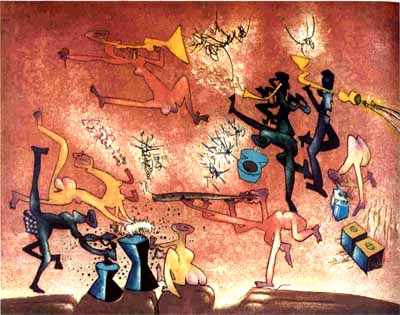
Saturday I watched the finale of the Olympics and the closing ceremony. Congratulations to the U.S.A basketball 'Redeem' team, the American men's volleyball team who overcame tragedy early on in the Olympics, as well as all the athletes that participated. It was a great two weeks of memories and inspiration. On Sunday I headed to the Chilean museum "Bellas Artes" both because my program's class is requiring us to visit and pick a favorite piece of art to write about at the end of our first essay as well as because on Sunday the museum is free. I love the Chilean surrealist Roberto Matta and I need to visit a museum nearby that is dedicated entirely to his work. Below is one of his titled "Jazz Band."

When I got home, I was overwhelmed with the tragic news that I received. I oped the door to my apartment and notice that there are two children inside. One only a year and a half old, the other nine. My host father Ivan was missing, while Luke my host mother was tending to the younger child. I quietly whispered to Luke what had happened and it turned out these kids were the children of a family on the first floor of my apartment building. Their father, training for the army, had been running with two other friends that morning and were tragically struck by the car of a drunk driver. One of the men was killed instantly, the father of the children and the other man were in the hospital. After entertaining the kids for a half-hour or so, Ivan came home from the hospital with the news that the father had died as well. The mother of the family does not work, and their financial situation is not that secure. Now with this taking place, they will probably have to move down south and look for work. My parents have been saints in helping out the window and her family with all of the arrangements necessary following this tragedy. It seems as though I hear stories about this type of situation happening every night on the news. What a terrible situation for this woman and her family.
Today I attempted to go purchase a textbook for my history course only to discover that the publishing company has stopped printing the book, and no new books will be available until September at the earliest. I need to talk to my teacher tomorrow about what to do, but I will probably just have to make photocopies from someone else. Apparently from what the bookstore worker told me, only 5 or six books were sold last Thursday, so not many students have a copy at all. Luckily we haven't been assigned any reading yet, so it shouldn't be a a big deal. I also tracked down my package from my family that contained my driver's license and my birthday present from my sister (board shorts). Thanks Casey! I love 'em.
That's all the news I have for now. Sorry I have been so slow in posting recently. Quite a busy week I had last week. Cheers.

My first impressions of school are as follows. One, my campus is quite liberal and diverse, which I obviously like. This manifests itself as variety of clothing styles, on campus drinking and smoking in social circles between and after class, and tons of on campus graffiti. One that caught my attention: "Bachelet rima con Pinochet" trans-> Bachelet (current president) rhymes with Pinochet (former dictator). The other observation I had about life is that none of the Chileans seriously consider the concept of punctuality. I was two minute early to my first class and the only person in the room was the professor. Most of the class arrived within 10-20 after it should have started. Not that I'm complaining or anything...
My second class, luckily in the same classroom, is a Social History of Latin America. As was the case previously, most of the class showed up late, including the teacher. Sadly this class is filled with foreign students, some from my program other from other abroad programs. We probably represent the majority. This is important to note since the professor of this class has a unique view on the history and development of Latin America and tends to announce his stern points about the United States (most of which are true) directly at a specific foreign student. Cracks me up. From the two classes I have had so far, this class seems very interesting and the teacher tremendously insightful. Just with their weren't so many gringos.
Following the these two back-to-back classes that take place Tuesday/Thursday, I have a nice, long break for lunch. At 7 p.m., the entire program has a dull history class located far from my apartment. I left on Tuesday at 6, and showed up a half hour late because of all the subway traffic. It's a battle down there; I missed 6 straight, packed subways. Strangely when I left at 5:30 on Thursday, transit was a breeze and arrived at 6:10. Bah! The course is a tough time of the day for us to be in class, but I assume they were forced to do this in order to avoid interfering with student's desired schedules of other University courses. Luckily we will have some interesting guest speakers every once in a while to break the trend. For now, its painful.
Wednesday I only had a three hour long class on rural life in Chile and the problems that these agricultural valleys encounter that started at 10:15 a.m. The location of this class was not clear on the first day and the teacher showed up 45 minutes late to his intended classroom. After an hour discussion in a small room about, we had a ten minute break and met back up at another classroom where the course supposedly started. I then realize that the class is two classes blended into one: there are two professors and two classes, one titled anthropology of the new rural life and the other sociology (mine) of the new rural life that together form anthro-sociology of the new rural life. Not sure how that works, but we'll see. The other odd thing about this class was that we spent the last 20 minutes of the classes immediately determining dates for field trips to visit two agricultural valleys in Chile: half the class to the Aconcagua valley and the other half to Cachapoal valley. Apparently, we need to select a topic of debate (water, labor, identity, memory, geography) in which we will be studying over the course of the year and investigating on these field trips. The first trip is 3 days long, the next 5 days, and the third 4 days. The teachers are not sure where we are going to stay, and I'm not sure how we are even getting there. Should be interesting... : / I had a a temporary heart-attack since the first trip is supposedly going to occur on the weekend in which the Chile vs. Brazil World Cup Qualifier is taking place. Thank god I also have a mandatory field trip with the entire Education Abroad program to a mine, "El Teniente" in the town of Sewell. I have to get all this confusion taken care of some time this week, but it shouldn't be a problem.
After a full day of class, and the dreadful evening course, I spent the evening with a buddy at the famous jazz club near my house to checkout a Miles Davis tribute that was absolutely incredible. I also found out the Jazz club is open on Wednesdays for blues nights, which I will most certainly be attending in the near future.
Friday's are free days for almost every student in Chile. That evening I went out to dinner with my buddy, his host family, some friends, and his older brother and wife who had traveled here to visit him. At dinner we had some excellent traditional Chilean dishes as well as some quality Chilean wine. I had not heard of the blend before, but the Carménère down here is excellent.
From Wikipedia, the free encyclopedia
The Carménère grape is a wine grape variety originally planted in the Médoc region of Bordeaux, France, where it was used to produce deep red wines and occasionally used for blending purposes in the same manner as Petit Verdot.
A member of the Cabernet family of grapes, the name "Carménère" originates from the French word for crimson (carmin) which refers to the brilliant crimson colour of the autumn foliage prior to leaf-fall. The grape is also known as Grande Vidure, a historic Bordeaux synonym, although current European Union regulations prohibit Chilean imports under this name into the European Union. Along with Cabernet sauvignon, Cabernet franc, Merlot, Malbec and Petit verdot, Carménère is considered part of the original six red grapes of Bordeaux, France.
Now rarely found in France, the world's largest area planted with this variety is in Chile in South America, with more than 4,000 Hectares (2006) cultivated in the Central Valley. As such, Chile produces the vast majority of Carménère wines available today and as the Chilean wine industry grows, more experimentation is being carried out on Carménère's potential as a blending grape, especially with Cabernet Sauvignon.
Carménère is also grown in Italy's Eastern Veneto and Friuli-Venezia Giulia regions and in smaller quantities in the California and Walla Walla regions of the United States.
The Carménère grape is a wine grape variety originally planted in the Médoc region of Bordeaux, France, where it was used to produce deep red wines and occasionally used for blending purposes in the same manner as Petit Verdot.
A member of the Cabernet family of grapes, the name "Carménère" originates from the French word for crimson (carmin) which refers to the brilliant crimson colour of the autumn foliage prior to leaf-fall. The grape is also known as Grande Vidure, a historic Bordeaux synonym, although current European Union regulations prohibit Chilean imports under this name into the European Union. Along with Cabernet sauvignon, Cabernet franc, Merlot, Malbec and Petit verdot, Carménère is considered part of the original six red grapes of Bordeaux, France.
Now rarely found in France, the world's largest area planted with this variety is in Chile in South America, with more than 4,000 Hectares (2006) cultivated in the Central Valley. As such, Chile produces the vast majority of Carménère wines available today and as the Chilean wine industry grows, more experimentation is being carried out on Carménère's potential as a blending grape, especially with Cabernet Sauvignon.
Carménère is also grown in Italy's Eastern Veneto and Friuli-Venezia Giulia regions and in smaller quantities in the California and Walla Walla regions of the United States.
Following dinner, we all attending a concert of a Chilean guitarist, Manuel García. He has an excellent voice as well as other members in his band that play great complimentary instruments: violinist, cellist, electric and base guitar, and a no older than 16 year old drummer. In addition to his own music, he plays a lot of Victor Jarra songs, which practically every Chilean knows by heart. The show was sold out and excellent. the clip below is one of his songs titled "El viejo communista->the old communist."
Saturday I watched the finale of the Olympics and the closing ceremony. Congratulations to the U.S.A basketball 'Redeem' team, the American men's volleyball team who overcame tragedy early on in the Olympics, as well as all the athletes that participated. It was a great two weeks of memories and inspiration. On Sunday I headed to the Chilean museum "Bellas Artes" both because my program's class is requiring us to visit and pick a favorite piece of art to write about at the end of our first essay as well as because on Sunday the museum is free. I love the Chilean surrealist Roberto Matta and I need to visit a museum nearby that is dedicated entirely to his work. Below is one of his titled "Jazz Band."
When I got home, I was overwhelmed with the tragic news that I received. I oped the door to my apartment and notice that there are two children inside. One only a year and a half old, the other nine. My host father Ivan was missing, while Luke my host mother was tending to the younger child. I quietly whispered to Luke what had happened and it turned out these kids were the children of a family on the first floor of my apartment building. Their father, training for the army, had been running with two other friends that morning and were tragically struck by the car of a drunk driver. One of the men was killed instantly, the father of the children and the other man were in the hospital. After entertaining the kids for a half-hour or so, Ivan came home from the hospital with the news that the father had died as well. The mother of the family does not work, and their financial situation is not that secure. Now with this taking place, they will probably have to move down south and look for work. My parents have been saints in helping out the window and her family with all of the arrangements necessary following this tragedy. It seems as though I hear stories about this type of situation happening every night on the news. What a terrible situation for this woman and her family.
Today I attempted to go purchase a textbook for my history course only to discover that the publishing company has stopped printing the book, and no new books will be available until September at the earliest. I need to talk to my teacher tomorrow about what to do, but I will probably just have to make photocopies from someone else. Apparently from what the bookstore worker told me, only 5 or six books were sold last Thursday, so not many students have a copy at all. Luckily we haven't been assigned any reading yet, so it shouldn't be a a big deal. I also tracked down my package from my family that contained my driver's license and my birthday present from my sister (board shorts). Thanks Casey! I love 'em.
That's all the news I have for now. Sorry I have been so slow in posting recently. Quite a busy week I had last week. Cheers.
Tuesday, July 22, 2008
Start to Break
What a coincidence, break began on Friday and Saturday afternoon there was a Chilean futbol match between La Chile (Universidad, but not affiliated with the school, just holds the name), and Union Española. I went to get some tickets on Saturday at the national stadium accompanied by my host father. Interestingly when I asked him to come with me to buy tickets, he misinterpreted that I wanted him to come to the game. He responded by saying that he couldn't go inside the national stadium because of the bad memories is brings him. During the Coup of Pinochet, troops used the national stadium as a torture and mass slaughter site. Famous Chilean musician Victor Jara was killed there, many believing troops chopped off his hands before execution. Shivers...
Anyways, we attended the match and it was a lot of fun. A passionate crowd nothing like anything in the states, and this is just the club league. Offensive songs, fireworks launched from the crowd, flares, the whole nine yards. Thank god La Chile won the match, 4-1 (almost 5-1). Afterward I was able to walk home since my house is less than 2 blocks away.

On Sunday, I went to go buy tickets for the National team futbol matches that will take place later this year. What a steal, Chile vs. Brazil, Colombia, Argentina for $50 US. Can't wait to see how those games play out. The two again Brazil and Colombia are World Cup Qualifiers and they mean a lot since in the Latin American group for the world cup, only the top 4 teams qualify with the 5th place team having to play a wild-card match against the 3 place team from the North American group. Currently Colombia leads the South American group, followed by Argentina, Paraguay, Chile and then BRAZIL. I am sure most of these teams will qualify but there is still a lot on the line.
On Monday night, one of my buddies in the program has a Spanish teacher from UC Davis who has dedicated his life's work to Chile and is an American. Michael Lazzara, PH.D. from Pricneton, is the real deal and recently published his 6th book. "Luz Arce: Después Del Infierno" his most current work is the story of a woman who worked close under Allende during the glory years, and then switched sides and turned on the party. He had a book publishing event last night at the National Library where in the audience was the widow of a former Allende supporter who was killed as a result of the side-switching by this woman.

Following excerpt readings from the book, the event turned into an open forum in which tough questions were posed as well as individuals making tense statements (one 15 minutes long). Chile is such an interesting country considering it was not long ago that the entire state was under a dictatorship and now it is currently seen as a model nation for the rest of Latin America. However, the polarized conditions of the masses cause a lot of angst and emotion when politics are brought up. The rapid transition from out of the horrors under Pinochet to general prosperity is unprecedented and makes discussing the past difficult. Too many people see the situation as black and white, whereas the goal of Mr. Lazzara is to try and change that mindset. A very powerful event, I was very lucky to be able to attend and then have dinner afterward. What an night.
I am going to try and head back to Valparaiso for the next couple days to show some friends around the city who haven't had a chance to visit it. Be back in a few days, cheers.
Chi-Chi-Ch-Le-Le-Le, Universidad de Chile!
Anyways, we attended the match and it was a lot of fun. A passionate crowd nothing like anything in the states, and this is just the club league. Offensive songs, fireworks launched from the crowd, flares, the whole nine yards. Thank god La Chile won the match, 4-1 (almost 5-1). Afterward I was able to walk home since my house is less than 2 blocks away.

On Sunday, I went to go buy tickets for the National team futbol matches that will take place later this year. What a steal, Chile vs. Brazil, Colombia, Argentina for $50 US. Can't wait to see how those games play out. The two again Brazil and Colombia are World Cup Qualifiers and they mean a lot since in the Latin American group for the world cup, only the top 4 teams qualify with the 5th place team having to play a wild-card match against the 3 place team from the North American group. Currently Colombia leads the South American group, followed by Argentina, Paraguay, Chile and then BRAZIL. I am sure most of these teams will qualify but there is still a lot on the line.
On Monday night, one of my buddies in the program has a Spanish teacher from UC Davis who has dedicated his life's work to Chile and is an American. Michael Lazzara, PH.D. from Pricneton, is the real deal and recently published his 6th book. "Luz Arce: Después Del Infierno" his most current work is the story of a woman who worked close under Allende during the glory years, and then switched sides and turned on the party. He had a book publishing event last night at the National Library where in the audience was the widow of a former Allende supporter who was killed as a result of the side-switching by this woman.

Following excerpt readings from the book, the event turned into an open forum in which tough questions were posed as well as individuals making tense statements (one 15 minutes long). Chile is such an interesting country considering it was not long ago that the entire state was under a dictatorship and now it is currently seen as a model nation for the rest of Latin America. However, the polarized conditions of the masses cause a lot of angst and emotion when politics are brought up. The rapid transition from out of the horrors under Pinochet to general prosperity is unprecedented and makes discussing the past difficult. Too many people see the situation as black and white, whereas the goal of Mr. Lazzara is to try and change that mindset. A very powerful event, I was very lucky to be able to attend and then have dinner afterward. What an night.
I am going to try and head back to Valparaiso for the next couple days to show some friends around the city who haven't had a chance to visit it. Be back in a few days, cheers.
Chi-Chi-Ch-Le-Le-Le, Universidad de Chile!
Tuesday, June 24, 2008
The Eagle Has Landed
After about 26 hours of straight travel, I have finally arrived. Left Lihue, Kauai a little after 10 p.m. local time, stopped in Honolulu for an unexpected refuel. Then continued on to L.A., then Miami for a 6 hour layover. It is now 7:18 a.m. EST (Chile), so you can do the math.
It was close to freezing when I stepped off the plane, but it is still early in the morning. Took less than 15 minutes to get from the the airport to the hotel thanks to a lack of traffic and a good driver. I have a room for the night at the Grand Hyatt in Santiago [thanks mom : ) ] on the 15th floor with a great view of the city. I am going to try and get a couple hours of sleep, and then do some exploring. Shopping mall across the street...and wow, as I type the sky has gotten lighter over the past few minutes to reveal a beautiful snowy mountainscape that overlooks the city. Sunrise in Santiago must be one of the most beautiful vistas I have seen in a while. Can't seem to find my power cord for my camera...not good. Still able to transfer a photo in.

It was close to freezing when I stepped off the plane, but it is still early in the morning. Took less than 15 minutes to get from the the airport to the hotel thanks to a lack of traffic and a good driver. I have a room for the night at the Grand Hyatt in Santiago [thanks mom : ) ] on the 15th floor with a great view of the city. I am going to try and get a couple hours of sleep, and then do some exploring. Shopping mall across the street...and wow, as I type the sky has gotten lighter over the past few minutes to reveal a beautiful snowy mountainscape that overlooks the city. Sunrise in Santiago must be one of the most beautiful vistas I have seen in a while. Can't seem to find my power cord for my camera...not good. Still able to transfer a photo in.

Subscribe to:
Posts (Atom)